For night shift workers who've tried everything and still feel wrecked
Why Melatonin Isn't Fixing Your Brain Fog
The reason your tired doesn't lift on your days off probably isn't about sleep at all. It's about one molecule your schedule quietly runs down, and why the fixes you've tried all aim at the wrong thing.

If you work nights, this is probably familiar.
You finish a 12-hour shift. You drive home with the windows down because you don't trust yourself to stay awake otherwise. You crash into bed at 8am. You wake up at 1pm feeling worse than when you laid down. The fog doesn't lift. Two coffees in, you're still running at a fraction of who you used to be.
You tell your partner you're fine. You're not.
You tell your doctor at the annual physical you're "just tired from work." She nods, runs your bloodwork, says it looks "borderline," and sends you home with a sleep hygiene printout you've already read.
You've tried melatonin. Magnesium. ZzzQuil. The blue-light glasses. The blackout curtains. The expensive mattress. Maybe a generic NMN bottle off Amazon that did nothing.
And it's still not working.
There's a reason for that. And it has nothing to do with how disciplined you are about your sleep.
The research on this job is not subtle
For decades, researchers have followed shift workers to see what the schedule does to them over time. The findings are consistent, and they are not small.
In the Nurses' Health Study, women who worked rotating night shifts for ten years or more had roughly 40% higher odds of type 2 diabetes. A separate analysis of 189,158 women followed for 24 years found higher coronary heart disease risk. And in a French study that tracked workers' mental sharpness for a decade, ten-plus years on shift work was linked to cognitive scores the researchers equated to about six and a half extra years of aging.
This is about the occupation, not any one person and not any product. It is here for one reason: if you have felt like something deeper than tiredness was wearing on you, the data says you are not imagining it.
What the research found on night shift work
Three of the largest long-term studies of nurses and workers
higher type 2 diabetes risk after 10+ years of rotating night shifts (Nurses' Health Study)
higher coronary heart disease risk (JAMA, 189,158 women, 24 years)
of brain aging linked to 10+ years of shift work (Occupational & Environmental Medicine, VISAT cohort)
Pan 2011; Vetter 2016; Marquié 2015
It can even show up at the cellular level
Researchers using DNA methylation, a biological measure of cell age, found that long stretches of night shift work were associated with cells testing slightly older than the worker's actual age. It is one more sign that the schedule reaches deeper than a rough night's sleep.

Every fix you've tried aims at sleep. The problem sits underneath sleep.
Google "shift work fatigue" and you get the same list every time:
- Melatonin
- Blackout curtains
- Blue-light glasses
- Magnesium
- "Sleep hygiene"
- "Get on a consistent schedule"
None of it is wrong. It just works on one layer: helping you fall asleep, stay asleep, or feel a little more rested.
But sleep loss isn't the deepest part of the problem. Night work disrupts something inside your cells that no amount of melatonin reaches, because melatonin doesn't work on that layer.
To see what's actually happening, you have to look at one molecule.
This is the molecule your job is silently draining. It has a name.
Inside every cell in your body, there's a coenzyme called NAD+, short for nicotinamide adenine dinucleotide.
You've probably never heard of it. Most people haven't. But you've heard of what it does.
NAD+ is the molecule that:
- Lets your mitochondria produce energy, the actual cellular currency that makes you feel "awake"
- Powers your cellular repair systems, including the ones that fix DNA damage
- Activates a family of enzymes called sirtuins (SIRT1, SIRT3) that regulate metabolism, inflammation, and how fast your cells age
- Maintains the rhythm of your internal clock
When NAD+ is high, you feel sharp, recover fast, sleep well, and your cells repair the damage life does to them.
When NAD+ is low, you feel like a shift worker on day three of a stretch. Wired but exhausted, foggy, and slow to recover.

Here's the part that matters:
By age 50, your NAD+ levels are roughly half what they were at age 20.
That's true for everyone, day shift or night. It's part of normal aging.
But shift workers don't get to run down on the normal schedule. The job speeds it up.
See what we built for the nights →
Two labs, working independently, found the broken switch melatonin can't reach.
In 2009, two simultaneous papers in the journal Science, one from Northwestern, one from UC Irvine, uncovered something nobody had seen before.
They discovered that NAD+ doesn't just decline gradually with age. It oscillates on a 24-hour cycle. Your cells produce more of it during certain hours and less during others. And the thing controlling that oscillation is your circadian clock.
Specifically: a pair of clock proteins called BMAL1 and CLOCK turn on an enzyme called NAMPT. NAMPT is the enzyme that builds NAD+. When BMAL1/CLOCK fire on schedule, NAMPT fires on schedule, and your NAD+ stays where it should be.
When BMAL1/CLOCK gets desynchronized, by, say, working at 3am under fluorescent lights, eating at 4am, and trying to sleep at 9am, NAMPT misfires.
And NAD+ collapses.
In 2013, another Science paper from Northwestern's Joseph Bass laboratory took it further. They showed that when they disrupted the BMAL1 clock in mice, the mice's mitochondria stopped working properly, and the only thing that fixed it was directly replenishing NAD+.
Read that one more time. The only thing that fixed mitochondrial damage from circadian disruption was replenishing the missing NAD+.
The fix was the molecule itself, put back.
Here's exactly what's breaking, in plain English.
Here's the chain. This is what happens inside your cells every time you work a night:
Your clock slips. NAMPT, the enzyme that builds NAD+, slows down. NAD+ runs low, so your mitochondria make less energy and overnight repair falls behind. Recovery gets longer, and the deficit is harder to climb out of.
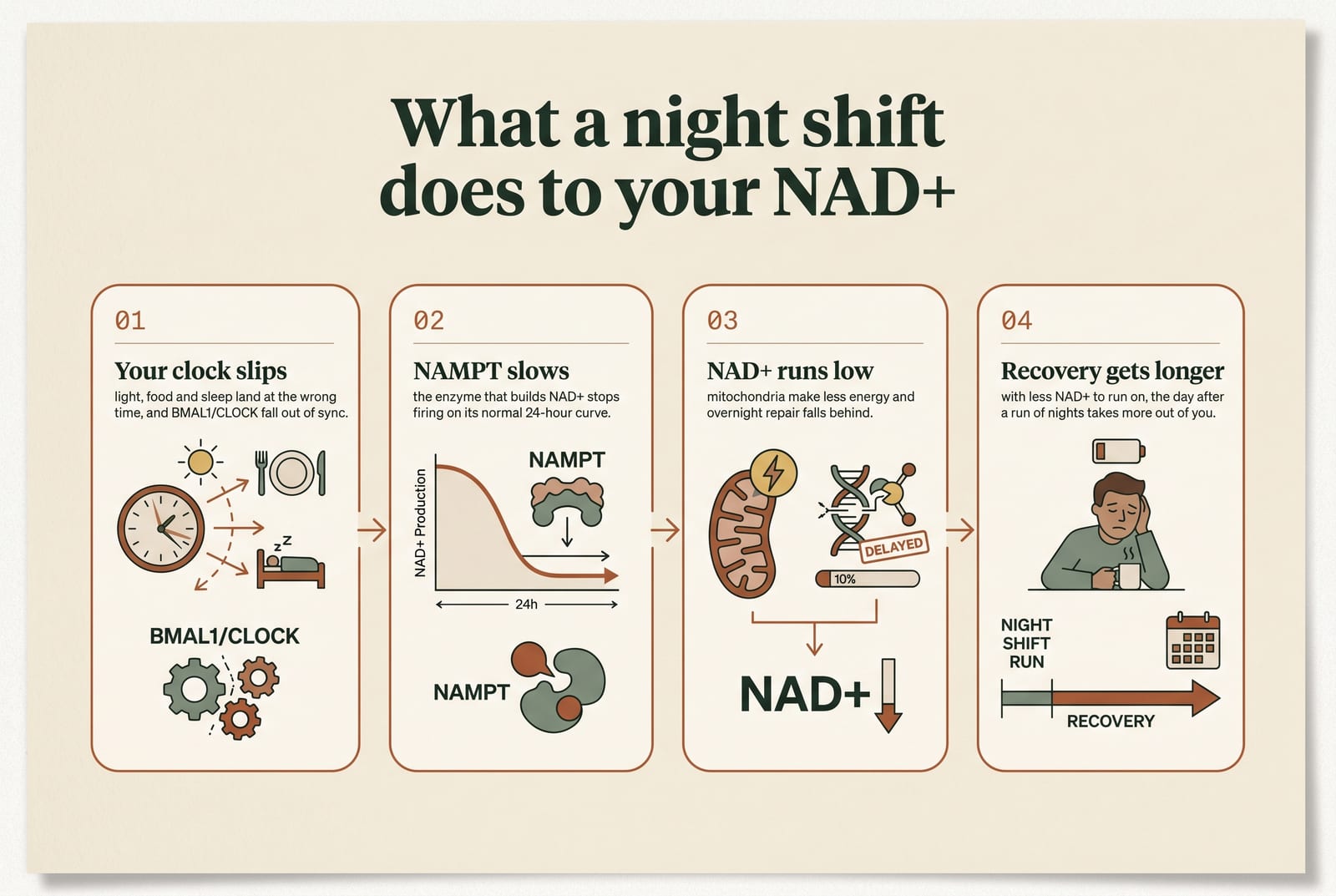
Melatonin can't fix this, because melatonin doesn't raise NAD+. It just helps you fall asleep at the wrong time.
You can sleep ten hours and still feel destroyed, because sleep doesn't refill NAD+.
Here's the part that should actually land as good news: this isn't a discipline problem, and it isn't permanent. It's a specific, physical thing, a molecule that's run low. And a molecule that's run low is a molecule you can put back.
"I tried NMN and felt nothing." Here's the part nobody tells you.
Maybe you already tried NMN. Heard about it on a podcast, bought a cheap bottle, took it for a few months, felt nothing, wrote it off.
Here's what you probably weren't told. When independent labs tested the NMN market, most products didn't contain what their label claimed. In one analysis of 22 top-selling NMN products, most had NMN levels below 1% of what was stated, and several contained none at all. Others were degraded or used the wrong form.
And NMN works dose-dependently: the more you take, the more your NAD+ rises. The human trials that showed the strongest, most reliable increases used 500mg and up. Plenty of cheap bottles are dosed at 125 or 250mg.
So "I tried NMN and felt nothing" is usually a bottle problem. Underdosed, degraded, or never tested. The molecule wasn't the issue.
What this adds up to
If you work nights, here's where it lands:
- The schedule is genuinely hard on the body. That part is well documented, and it's the job, not a personal failing.
- The reason you feel the way you do is physical, not behavioral. It runs through your clock, your NAD+, and your cells, which is why sleep fixes only go so far.
- The molecule that runs low has a name, NAD+, and NMN is the precursor your body uses to raise it.
- You can't undo the schedule. The work is the work. But you can stop running the deficit, and the earlier you start putting it back, the better.
So we built the thing we couldn't find
The NAD+ aisle is built for biohackers, retirees, and the longevity-curious, people running expensive optimization protocols. Almost none of it is made for the people whose schedule is the actual cause: the nurses, pilots, paramedics, firefighters and shift leads who keep things running while everyone else sleeps.
We're Stratus Labs. Stratus was started by a commercial pilot who lived the same fog you live, looked at the same useless bottles, and wanted one he could actually trust.
So ours is one ingredient. 500mg of NMN, the dose used in the human trials. Every batch is third-party tested, and we publish the results with the batch number. It won't make 4am easier. What it's for is the part that's supposed to come back and stops: the day after the night, the weekend after a run of three.
You've read what the schedule does. Here's what we built for it.
The 90-day supply comes to about $1.39 a day on subscription. If you've been buying melatonin and magnesium that did nothing, you've likely spent more than that, for years, on the wrong layer.
The 90-day guarantee makes it easy. Take it for three months. If you feel nothing, send back whatever's left, get refunded, and keep the bottle.
Every stretch of nights you run without putting NAD+ back is a little more to climb out of later. That's the honest case for starting now instead of telling yourself you'll get to it.
See what we built, and judge it by one thing: how your days off feel.
P.S. None of this is a cure, and the schedule isn't going anywhere. What changes is the recovery, the day after a run of nights, the weekend you usually lose. The guarantee runs 90 days, so finding out costs you nothing but the time it takes to feel it.
A molecule that's run low is one you can put back.
Pay down the night shift debt90-day money-back · Keep the bottle · Cancel anytime · Free shipping